Week of Sept 15:
I have identified the term "Living Skin" as the possible architectural theory behind what I am going to pursue for this Slocum Hall intervention. Without a doubt in my mind, what I do will have to do something one way or antoher with Skin; the concern left now is defining what skin is.
Dictionary gives 36 definitions of Skin,
-noun
1. the external covering or integument of an animal body, esp. when soft and flexible..
4. any integumentary covering, casing, outer coating, or surface layer, as an investing membrane, the rind or peel of fruit, or a film on liquid: a skin of thin ice; the aluminum skin of an airplane.
–verb (used with object)
16. to strip or deprive of skin; flay; peel; husk.
Lemon
Yet none of these begin informing what I have already learned through detailed studies of a Lemon and its skin. A Lemon Skin changes with time; morphing shape, losing flexibility, and all around reversing the qualities originally associated with a lemon skin.
Article
Using the article Digital Skins; The Architecture of Surface by Alicia Imperiale, I am confronted by a writer who uses language that helps describe this organic condition.
>"Skin is the space of flux, of oscillating conditions." p.55
>"Smooth exchange, flow, continuous surface, skin, membranes, bubbles..." p.55
>"Because the system is networked, a change in any component of hte system is registered in other parts of the skin." p.61
>"Today some architects compress allusions to the depth of the interior into the surface or skin of a building." p. 56
>"The living skin varies dramatically as it adapts to the exigencies of the body--thick where the skeleton needs some padding to soften contact, hardened in response to friction." p. 56
>"Deleuzean thought has promoted smoother transitions and interactive exchanges across surfaces through serendipitous, temporary links that exist within buildings and sites." p.62
The language here begins to develop into this creature that fluxates and reacts upon a continuous surface. It has depth and fragility, tension and limpness.
Human Skin
Skin also protects; from climate and external influences.. It experiences Sensation; nerves that react to heat and cold, touch, pressure, vibration, and injury. It stores nutrients and water.
Skin has 3 primary layers:
waterproofing barrier,reactive layer
provides sense of touch/heat/function
insulation
Skin is flexible and responsive,
Showing posts with label surface. Show all posts
Showing posts with label surface. Show all posts
Tuesday, September 16, 2008

Monday, September 15, 2008
Ex. 2 Boundary Logics

This exercise involves mapping a site, evaluating the different forces that play upon its boundaries, and situating a project within that site that will act as an agent of engagement. Ultimately, this will involve the creation of an insertion into an existing context, with he mission to increase areas of engagement of Slocum Hall into its surrounding context.
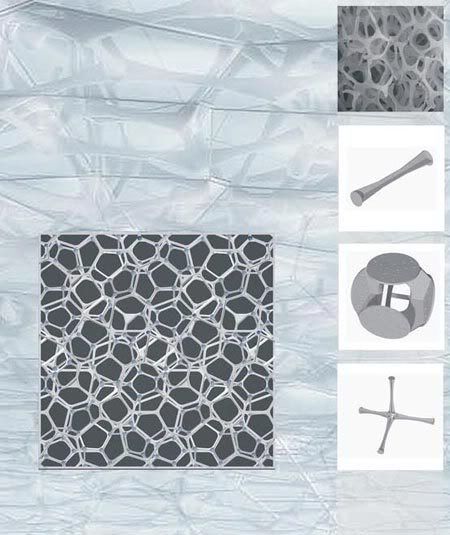 Herzog and Demeuron; Designing a continuous surface based on water molecules
Reworking the Entry:
You are asked to modify the threshold condition on one of the four sides of Slocum Hall in order to connect previously disconnected areas of the site through addition and subtraction of surfaces, determining a new pattern of organization for the site.
Some rules: Major work on the building per se, that is, addition or subtraction on the facade and nearby areas, may occur in a zone of five feet measured on either side of the center line of the building wall, that is, a ten-food-wide slot, centered on the center-line of the wall. Other surface treatments which extend beyond or into the building may extend as far as necessary for your project. You may ADD surface elements, such as ramps, stairs and benches, so long as they are conceptually a part of the ground/surface condition. You may subtract elements such as parts of existing walls and ground planes. you may layer surfaces. Your 'new pattern of organization' must make sense of, and extend the possibilities of, the logics you have uncovered on the site in part one of this exercise. Make maximum change with minimum of elements.
Programmatic Concerns
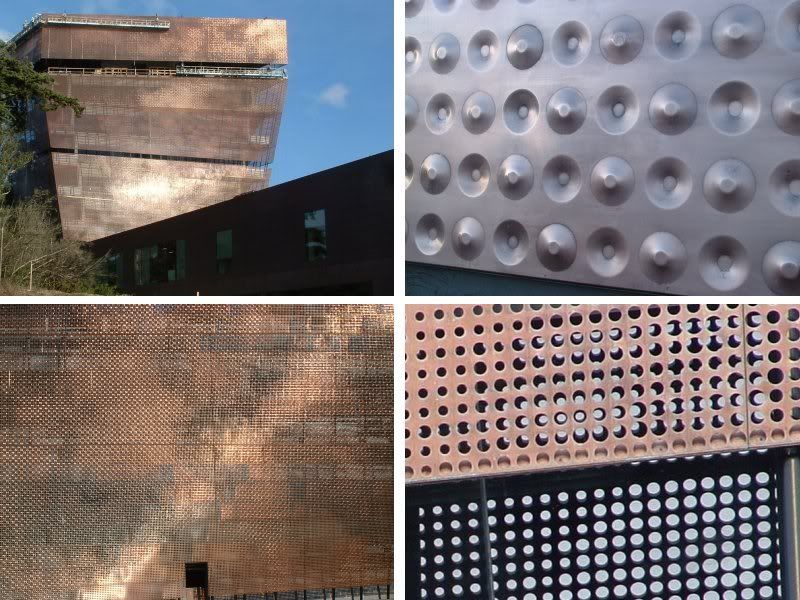
-Surface continuities/flows from inside to outside or across apparently disparate parts of the site, not towards the elimination of difference, but towards forming new pairings and logical continuities between the pairings.
-Systematic deployment of two primary materials: 1)One material that already exists in Slocum Hall and 2) Use of one new material used by an architect you study.
-Waiting, as in waiting for friends, smoking, or bus waiting; and watching, as in people-watching, small scale theater, video screens, exterior feeds of interior conditions, or of student work. You must consider dimensional logics of such elements.
-Movement, as in the movement of may bodies in and out of the building for class, movement of casual visitors to view the works inside the building or use the cafe, and the exiting of many bodies in case of emergency.
Each Scheme should consider, as appropriate:
-Handicapped accessibility
Process:
Use the same technique of carefully configured B+W photographs and diagrams to describe each design iteration.
Issued: Friday, September 12, 2008
Due: First iteration due Tuesday, Sept. 16
Final: Thursday, Sept. 25
Subscribe to:
Posts (Atom)